How to Play Blackjack (Without Losing Money First)

Most guides explain blackjack like a rulebook. Here, I’m going to show you the rules, but also how those rules play out, where people lose money, and what decisions actually change your results at a live table.
Blackjack rules: The basics ♥️♣️♦️♠️
The first blackjack rule to understand is that you're not trying to beat other players. You’re trying to beat the dealer.
You win if:
- Your hand is closer to 21 than the dealer’s
- OR the dealer busts (goes over 21)
You lose if:
- You bust
- OR the dealer finishes closer to 21 than you
What the table looks like (and why it matters)
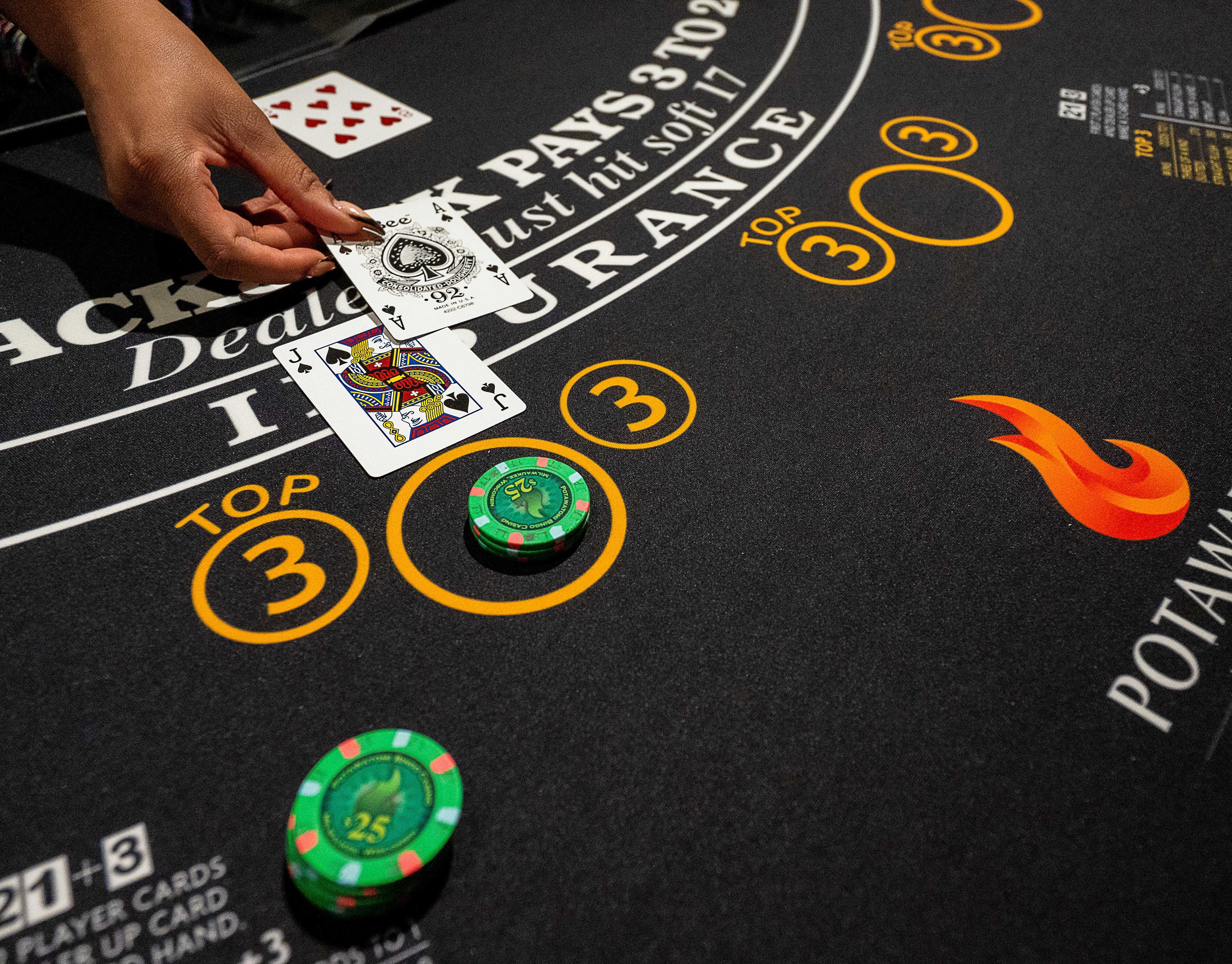
A standard blackjack table runs:
- 1 to 7 players
- 1 dealer
- 1 to 8 decks of cards (most Canadian and US casinos use 6 or 8)
Each player gets their own hand. You don’t share cards or decisions with others, even if people act like you do.
Real table note:
At a busy table in Las Vegas last year, I saw a player blamed for “taking the dealer’s bust card.” That’s superstition. Every card is already set in the shoe. Your decision doesn’t change the sequence.
Card values (quick and important)
- Number cards = face value
- Face cards (J, Q, K) = 10
- Ace = 1 or 11
That Ace flexibility is the most important rule in the game, and understanding how it works can be the difference between winning and losing.
Example:
- Ace + 7 = 8 or 18
- If taking another card would bust at 11, it switches to 1 automatically
How to play blackjack: Breaking down the game
Having a sense of what to expect from a table before you sit down and start wagering can give you the confidence and comfort you need to make great decisions. Here’s the real step-by-step flow of what actually happens at a blackjack table.
1. You place your bet
All chips go in the betting circle before any cards are dealt.
2. Cards are dealt
- You get two cards (face up)
- The dealer gets two cards (one face up, one face down)
3. You make decisions
This is where the game is won or lost.
You can:
- Hit (take another card)
- Stand (keep your total)
- Double down (double your bet, take one card)
- Split (if you have a pair)
- Sometimes surrender (give up half your bet)
I'll thoroughly break down how each of these decisions work in just a bit.
4. Dealer plays
The dealer follows strict rules:
- Must hit on 16 or less
- Must stand on 17 or more (sometimes hits soft 17 depending on the table)
5. Payouts happen
Winning hands usually pay 1:1. This means that if you wager $10, and you beat the dealer, you'll win $10.
Blackjack normally pays 3:2, but there are some tables that pay worse. We recommend looking for a 3:2 table. This means that if you wager $10, and you get a blackjack, you'll win $15.
The five decisions that matter
Most beginners overthink blackjack. In reality, winning and losing comes down to five choices.
1. Hit
Take another card. You’re simply asking one question: “Am I more likely to improve, or bust?”
Example: You have 12 vs dealer 10
You should hit, even though it feels risky. I’ve watched hundreds of players stand here. It feels safe, but it’s mathematically worse.
2. Stand
You keep your total and let the dealer play. This is best used when your hand is strong (17 or higher) or the dealer is likely to bust.
3. Double down
You double your bet and take exactly one more card. Play this right and it’s a great chance to increase your profit.
Common strong spots:
- 11 vs dealer 6
- 10 vs dealer 9 or lower
Real example from my own play:
I doubled on 11 vs dealer 6 at a $25 table, and pulled a 10. Meanwhile, the dealer busted.
That single decision turned a $25 hand into a $50 profit. Over time, using these strong double-down spots correctly can add up.
4. Split
If you’re dealt a pair, you can split into two hands.
But not all pairs are equal.
Always split:
- Aces
- 8s
Never split:
- 10s
Why?
- Aces give you two chances at strong hands
- 8s turn a bad 16 into two better hands
- 10s already make 20, which is strong enough
5. Surrender (if available)
You forfeit half your bet and exit the hand.
This is rare in land-based casinos but common online.
Best used when:
- You have 16 vs dealer 10
- Or 15 vs dealer Ace
It feels like giving up, but surrendering in these spots saves you money over the long term, as playing the hand out is unlikely to provide a successful result.
What counts as blackjack?
It might be in the name, but the game isn’t all about hitting blackjack. However, it’s the best way to increase your winnings at the table.
“Blackjack” is when you hit an ace and a 10-value card on your first two cards. Blackjack pays 3:2, not 1:1. So a $10 bet = $15 profit rather than the usual $10 profit from a normal winning hand.
Watch out:
Some casinos offer 6:5 payouts. That sounds like a small difference, but it increases the house edge a lot.
Blackjack rules for the dealer
In blackjack, you only have control over the decisions based on your cards and what you see on the table. The dealer has no control over their cards. Instead, the game dictates that they have to take certain actions in given situations.
Understanding the dealer rules in blackjack is where you can give yourself a bit of an advantage, as it is where the game becomes more predictable. This is because the dealer
- Cannot make decisions
- Must follow fixed rules
- Will bust roughly 28% of the time
The dealer cannot stand on anything below 17. They have to hit (take cards) until they reach a total of 17 or more. This means even if they are on 16, they have to hit. As soon as the dealer’s card total is 17 or more, they stand.
Blackjack side bets and payouts
In addition to the standard 1:1 for beating the dealer, and 3:2 for blackjack, there are additional ways to increase the payouts at a blackjack table. Naturally, like all gambling, an increased payout means an increased risk.
| Side bet 💰 | Payout 🤑 | How it works 📝 |
|---|---|---|
| Insurance | 2:1 | A bet on if the dealer has blackjack when their face card is an ace. |
| Mixed pair | 5:1 | Your two cards are the same number/picture but different colours (queen of hearts and queen of spades) |
| Coloured pair | 10:1 | Your two cards are the same number/picture, and the same colour (six of clubs and six of spades) |
| Perfect pair | 30:1 | Your two cards are exactly the same. |
| 21+3 (flush) | 5:1 | Your two cards and dealer’s face card are the same suit. |
| 21+3 (straight) | 10:1 | Your two cards and dealer’s face card are in sequence. |
| 21+3 (three of a kind) | 30:1 | Your two cards and the dealer’s face card are all the same number/picture. |
| 21+3 (straight flush) | 40:1 | Your two cards and dealer’s face card are in sequence and the same suit. |
| 21+3 (suited three of a kind) | 100:1 | Your two cards and dealer’s face card are all the same number/picture and suit. |
| Super Sevens | 3:1 - 5000:1 | Based on how many sevens on the table. One seven is the lowest payout, three sevens (your two cards + dealer’s face card) of the same suit is the biggest. |
In addition to the above side bets, you will also find a range of different side bets available at different casinos.
How to play blackjack: A simple strategy that actually works
You don’t need to memorise a giant chart to start playing better. I’ve got a simplified version of blackjack strategy that will help you understand the game better and help you make quick decisions that you can confidently stand by, even if they don't always produce favorable results:
- ✅ Always hit 11 or lower
- ✅ Stand on 17 or higher
- ✅ Hit 12–16 if dealer shows 7 or higher
- ✅ Stand 12–16 if dealer shows 2–6
- ✅ Always split Aces and 8s
- ✅ Never split 10s
- ✅ Double on 10 or 11 when dealer shows a weaker card
This alone cuts the house edge down to around 0.5% at good tables. If you compare that to random play, which can push it over 2–3%, you’re instantly in a better spot by following these basic rules.
Visual example of a hand
Let’s walk through a real scenario.
You have:
- 10 + 6 = 16 Dealer shows: 10
What most people do:
Stand (because 16 feels “high”)
What correct play says:
Hit
Why?:
- Standing loses more often
- You’re already likely to lose unless the dealer busts
- Taking a card gives you a chance to improve
This is one of the most misplayed hands in blackjack.
Common mistakes I see every session
These mistakes come up constantly, both in casinos and online.
- Standing on 12 vs dealer 2
It feels safe. It isn’t. You should hit.
- Taking insurance - Insurance is a side bet when the dealer shows an Ace.
It pays 2:1 if they have blackjack. Sounds fair. It isn’t. Over time, it’s a losing bet. I never take it.
- Splitting 10s
It looks exciting, but it’s usually a mistake. You’re turning a strong 20 into two weaker hands.
- Chasing losses with bigger bets
This isn’t a blackjack rule, but it’s the fastest way to lose money. The game has a small edge. Changing your bet size doesn’t remove it.
In-person vs online vs live dealer blackjack
I’ve played in-person, online, and live dealer blackjack thousands of times over the last couple of decades, and they don’t play the same. It's worth thinking about the differences to help you know where you want to start your blackjack journey.
| In-person blackjack ♣️ | Online blackjack ♥️ | Live dealer blackjack ♠️ |
|---|---|---|
| Slow pace (50-70 hands per hour) | Faster hands (80 to 120+ per hour) | Slower pace (60-80 hands per hour) |
| Conversations/reactions from other players | No pressure from other players | Real dealer via video |
| Casino atmosphere with potential distractions | Easier to follow your strategy | Live casino “feel” |
Your preference might be based on the setting you want to play in. If you want control over the atmosphere, then a land-based casino isn’t a great option. If you're looking to implement a strategy, you probably want to play on an app with a real money online casino so you can use reference material and guides.
The biggest thing for me, and to consider as a beginner, is the impact that where you play blackjack has on your bankroll. In-person and live dealer games are much slower, so you will burn through money quicker when playing standard online blackjack.
What actually gives you an edge
Blackjack is one of the few casino games where your decisions matter. But let’s be clear; you don’t beat the casino long term without advanced techniques like card counting (and that’s not practical in most modern games).
What you can do once you learn how to play blakcjack is reduce losses, extend your playtime, and avoid bad bets.
Should you start playing blackjack?
I’m a big fan of blackjack, but I get that it’s not for everyone. I’ve put together a brief list below to help you decide if you’re the type of person who will enjoy blackjack, or maybe someone who is better suited to a different casino game. If you prefer a game like slots, or want to play something easy on your phone, you can take advantage of online casino bonuses and get started that way instead.
| Blackjack works best for 🟢 | Who won’t enjoy blackjack 🔴 |
|---|---|
| Players who like making decisions | You want the chance to win big on small bets |
| People willing to learn basic strategy | You want pure luck with no thinking |
| Anyone who wants lower house edge than slots | You chase losses or tilt easily |
| You’re playing for quick wins |
Advice from my experience with blackjack
Blackjack looks simple, but it isn’t. However, it’s also not complicated once you stop guessing and start following a structure. Most players don’t lose because the game is unbeatable. They lose because they play by instinct instead of probability.
Using a blackjack strategy might feel daunting, but it’s much easier than it seems.
Frequently asked questions

Yes, always hit.
A dealer showing 10 is in a strong position, and your 16 loses more often by standing than by hitting. You're hoping to pull a 2, 3, 4, or 5 to improve your hand, and the math favors taking that risk over surrendering to a likely dealer 20.
If surrender is available, that's actually the optimal play—but most tables don't offer it, so hitting is your best move.
Always assume the dealer's face-down card is a 10.
This single assumption drives nearly every basic strategy decision. If the dealer shows a 6, you're assuming they have 16 and will likely bust. If they show a 10, you're assuming 20 and playing more aggressively.
It's not always true, but it's statistically the most likely scenario, and it keeps your decision-making sharp.
Most players won't, but blackjack gives you the best shot of any casino game.
With perfect basic strategy, the house edge drops to around 0.5%, meaning you're nearly playing an even game. Compare that to slots or roulette, where the house edge is significantly higher.
Card counting can tilt the odds in your favor, but it requires serious practice, bankroll management, and isn't viable online where decks shuffle after every hand. For most players, blackjack is about minimizing losses and maximizing entertainment value, not consistent profit.
No—betting systems don't change the house edge.
The 1-3-2-6 system and others like the Martingale sound appealing because they create structure, but they don't improve your odds of winning. They just redistribute your risk across hands, and one bad streak can wipe out your progress.
Flat betting—wagering the same amount each hand—is the safest approach for beginners. It keeps your bankroll predictable and lets you focus on learning strategy instead of chasing losses.
A soft hand contains an Ace counted as 11 without busting. A hard hand either has no Ace, or the Ace must be counted as 1 to avoid going over 21.
Soft 17 = Ace + 6 (can't bust on the next card)
Hard 17 = 10 + 7 (one more card could bust you)
This distinction matters because soft hands give you flexibility—you can hit aggressively without the risk of busting, which changes your strategy. Always play soft hands more aggressively than their hard equivalents.