
🤖 March Madness AI Bracket Predictions 2026: We Trained Claude to Pick Every Game


This is the third year I've published my March Madness AI bracket predictions ahead of the NCAA Tournament, and this time I switched from ChatGPT to Claude - the advanced AI model from Anthropic - to see if the trendy chatbot could do what no human ever has: predict the correct winner for all 63 games to pick a perfect bracket.
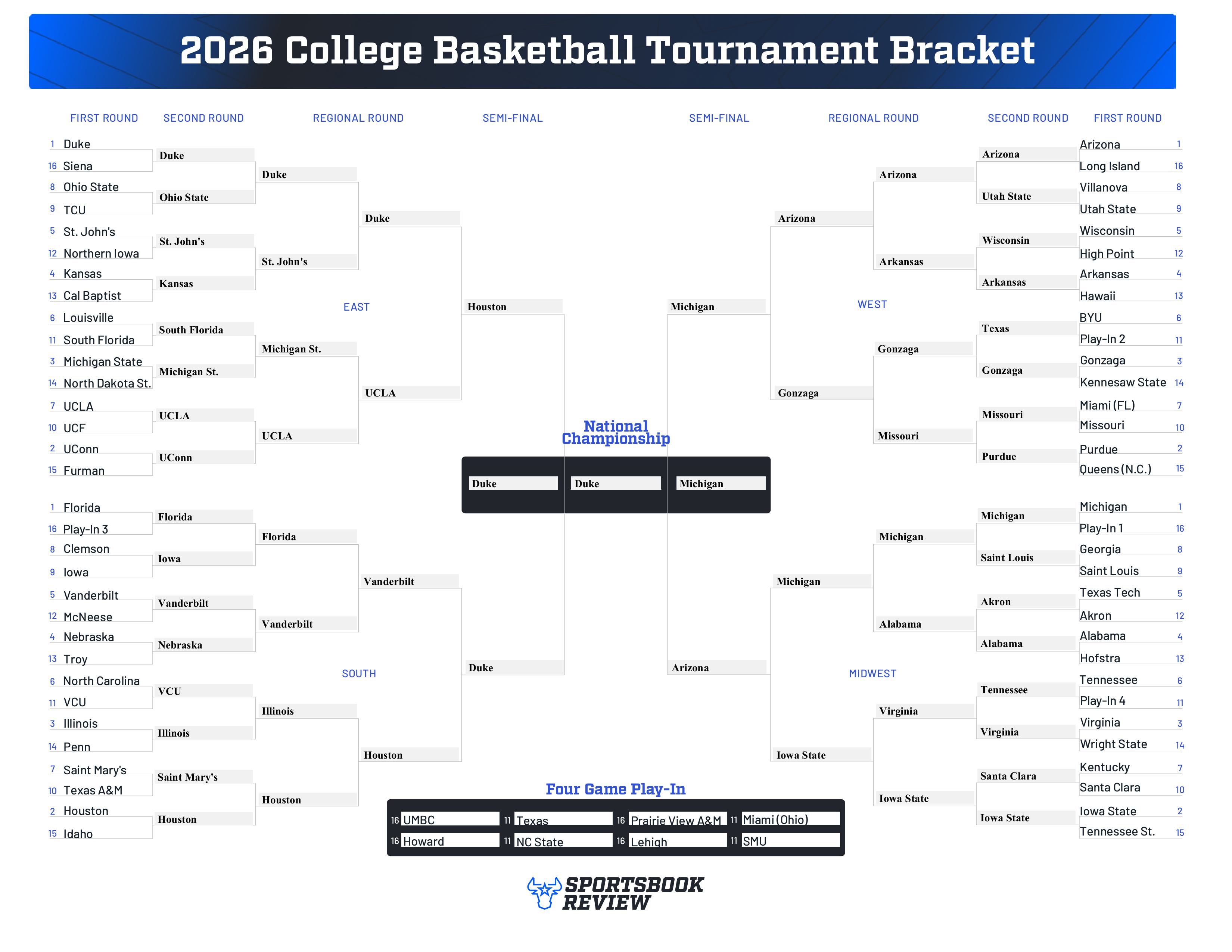
Here's a look at my March Madness AI bracket predictions with exact score projections for all 63 games of the 2026 NCAA Tournament from the first round to the championship game. These picks are meant for entertainment, though I will be submitting them in my own personal March Madness bracket contests.
🏆 AI pick to win March Madness
In 2024, AI correctly picked UConn to win the national championship while correctly picking 60.3% of games across the tournament. In 2025, it leveled up: going 28-for-32 in the first round, correctly identifying all eight Elite Eight teams, and ranking in the top 1.8% of ESPN Tournament Challenge brackets entering the second weekend before finishing in the top 12% overall with a 79.4% success rate.
🤖 March Madness AI bracket process
This year's bracket is the most thoroughly researched and scrutinized version I've ever done with the best model I've ever had available (Claude Opus 4.6). I spent an entire day training Claude on KenPom and Bart Torvik efficiency data, historical upset trends, injury reports, conference tournament results, coaching records, betting lines, venue factors, and expert consensus picks - then walked through the March Madness bracket round by round, stress-testing every pick to ensure AI's reasoning was based in evidence.
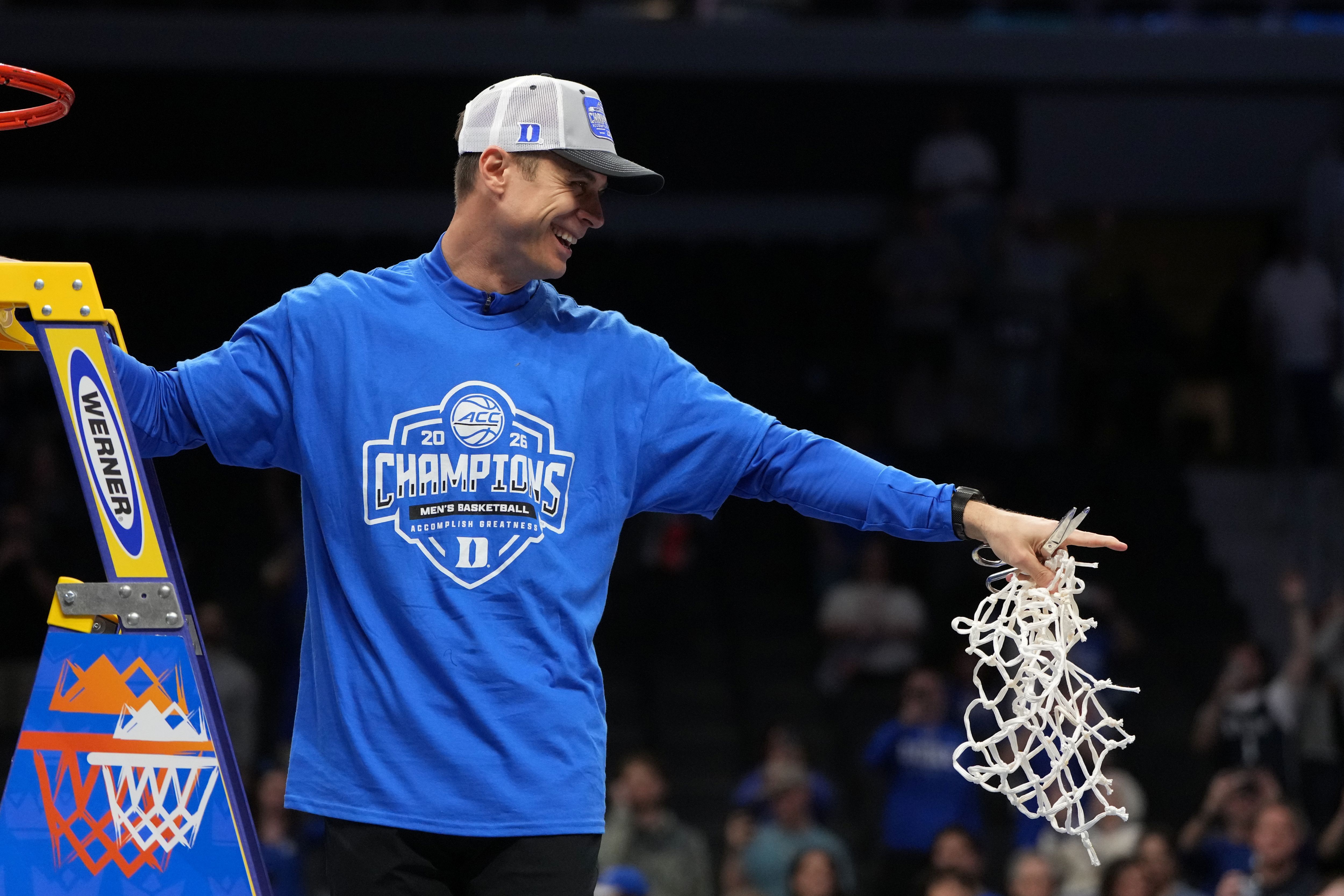
Claude is picking the Duke Blue Devils to win the 2026 NCAA Tournament. Here's what it had to say about why Duke will win the national championship:
"The No. 1 overall seed enters March Madness at 32-2 with the best player in college basketball — freshman Cameron Boozer, who is on pace for the highest individual offensive rating in KenPom history. Boozer is averaging 22.7 points, 10.2 rebounds, and 4.2 assists while shooting 41% from three. He's the runaway favorite for National Player of the Year, and his combination of size, skill, and clutch shot-making gives Duke a trump card that no other team can match.
But this pick isn't without risk. Duke will play the entire tournament without starting point guard Caleb Foster, who suffered a broken right foot in the regular-season finale against North Carolina and is out until at least the Final Four. Starting center Patrick Ngongba II missed the ACC Tournament with foot soreness and remains day-to-day. Duke won the ACC Tournament without both starters — an impressive feat that speaks to Jon Scheyer's coaching and the depth of this roster — but navigating six tournament games with a shortened rotation is a different challenge entirely.
So why Duke? Because Cameron Boozer is the kind of generational talent who bends games to his will, and he's already proven he can do it shorthanded. Duke's defense remains elite (No. 1-2 nationally in adjusted defensive efficiency) even without Foster and Ngongba. Freshman Cayden Boozer has grown into the starting point guard role with back-to-back 16-point games in the ACC Tournament. And Scheyer has led Duke deeper into the tournament in each of his four seasons — Round of 32, Elite Eight, Final Four, and now, Claude believes, a national championship."
Boozer is the consensus favorite by the March Madness MVP odds.
🤖 AI March Madness bracket predictions
Click here to download the full AI March Madness bracket.
Don't trust the robot? We have you covered with our March Madness expert bracket predictions and our comprehensive guide on how to fill out a March Madness bracket.
📊 March Madness AI bracket record
See all of our college basketball picks based on the latest college basketball odds.
This is the third year we've asked AI to fill out a March Madness bracket. Here's how the model has performed:
| 2024 (ChatGPT) | 2025 (ChatGPT) | 2026 (Claude) | |
|---|---|---|---|
| Picked winner | ✅ (UConn) | ❌ (Florida won) | TBD |
| Title matchup | UConn over Houston | Duke over Auburn | Duke over Michigan |
| First round | 21/32 (65.6%) | 28/32 (87.5%) | TBD |
| Sweet 16 teams | 10/16 (62.5%) | 12/16 (75%) | TBD |
| Elite Eight teams | 3/8 (37.5%) | 8/8 (100%) | TBD |
| Final Four teams | 2/4 (50%) | 2/4 (50%) | TBD |
| Total correct | 38/63 (60.3%) | 50/63 (79.4%) | TBD |
Across two years, AI has correctly predicted 88 of 126 total tournament games (69.8%), including 49 of 64 first-round games (76.6%) and 22 of 32 second-round matchups (68.8%). It picked the national champion correctly in its first attempt and went a perfect 8-for-8 on Elite Eight teams in 2025. Last year's bracket ranked in the top 1.8% of all ESPN Tournament Challenge entries entering the second weekend before finishing in the top 12% overall — a massive improvement from Year 1's 38 correct picks to Year 2's 50.
Check back throughout the tournament as I update this table with Claude's 2026 results.
👠 AI March Madness upset predictions & Cinderella picks
After a historically chalky NCAA Tournament last year, Claude predicted six double-digit seeds to pull off first-round upsets this year, plus three 9-over-8 coin flips - right in line with the historical average of 8-10 lower-seeded teams winning in the first round and with the rest of our March Madness bracket predictions.
The biggest upset by seed differential is No. 12 Akron over No. 5 Texas Tech, a pick driven by JT Toppin's season-ending ACL tear and the Red Raiders' three-game losing streak entering the tournament. Akron is 29-5 with a top-55 offense nationally, and Claude believes the Zips' offensive firepower will exploit a Texas Tech defense that just lost its anchor.
Here's a full list of every upset Claude predicted in the first round involving a double-digit seed, ranked by seed differential:
- (12) Akron over (5) Texas Tech
- (11) South Florida over (6) Louisville
- (11) VCU over (6) North Carolina
- (11) Texas over (6) BYU
- (10) Missouri over (7) Miami (FL)
- (10) Santa Clara over (7) Kentucky
Beyond the first round, Claude's boldest picks include Vanderbilt knocking off defending champion Florida in the Sweet 16 (a rematch of the Commodores' 91-74 demolition of the Gators in the SEC Tournament semifinals), UCLA's Cinderella run through UConn and Michigan State, and Missouri pulling off a stunning upset of No. 2 Purdue in the Round of 32 in St. Louis, where the Tigers were essentially playing at home.
Want more upset picks? Check out our March Madness upset predictions and our guide on the most common March Madness upsets.
📃 Affiliate disclosure
Sportsbook Review may receive a commission if you sign up through our links. Not intended for use in MA. Bonuses not applicable in Ontario. 21+ only. (Gambling problem? Call 1-800-GAMBLER)
1️⃣ March Madness AI picks & score predictions: First round
Upsets noted with a 🔥
East Region
(1) Duke 84, (16) Siena 57 – Cameron Boozer is having the greatest individual offensive season in KenPom history, and Duke's defense remains No. 1-2 nationally even without injured starter Caleb Foster. Siena's coach Gerry McNamara is making his first tournament appearance as a head coach. Duke by nearly 30.
(8) Ohio State 74, (9) TCU 69 – Ohio State has been on a heater — covering five straight and going 8-1 ATS in their last nine, including pushing No. 1 Michigan to a four-point game in the Big Ten quarters. TCU won nine of ten before a loss to Kansas, but Ohio State's momentum and defensive edge tip this coin flip.
(5) St. John's 74, (12) Northern Iowa 61 – St. John's is the most underseeded team in the bracket — KenPom No. 16 as a 5-seed, with multiple models viewing them as a 2 or 3. They demolished UConn 72-52 in the Big East final. Northern Iowa's defense is legitimate, but UNI's offense can't match St. John's talent level.
(4) Kansas 76, (13) Cal Baptist 63 – Darryn Peterson has been carrying a full workload since mid-February and looks like the generational talent he is when healthy. Cal Baptist's Dominique Daniels Jr. can score 23 a night, but his inconsistency gets punished against Kansas' No. 10 defense.
(11) South Florida 74, (6) Louisville 70 🔥 – My highest-conviction upset. Mikel Brown Jr. has missed 12 games with a back injury, including the entire ACC Tournament. Louisville is 7-5 without him, and Pat Kelsey is 0-5 in career tournament games. South Florida has won 12 straight, and Izaiyah Nelson won both AAC Player and Defensive Player of the Year.
(3) Michigan State 80, (14) North Dakota State 62 – It's Izzo. It's March. It's the 28th consecutive tournament appearance. NDSU won the Summit League but hasn't faced anything close to this level. Michigan State's defensive versatility smothers the Bison.
(7) UCLA 76, (10) UCF 68 – UCLA has won six of their last eight, including three top-10 wins. Donovan Dent had a triple-double in the Big Ten Tournament. UCF enters on a 1-4 slide — the worst recent form of any tournament team. Momentum matters in March.
(2) UConn 80, (15) Furman 58 – Dan Hurley chasing a three-peat with battle-tested seniors Alex Karaban and Tarris Reed Jr. Furman is KenPom No. 190. Not the game where UConn stumbles.
South Region
(1) Florida 86, (16) Lehigh 59 – The defending national champions have a top-10 offense and top-6 defense. They lost to Vanderbilt by 17 in the SEC semis, but a first-round game against a 16-seed is exactly the reset a championship team needs.
(9) Iowa 75, (8) Clemson 71 – Iowa is KenPom No. 25 while Clemson sits at No. 36, and Clemson just lost starter Carter Welling to a torn ACL in the ACC Tournament. Iowa's glacial tempo will grind this into a half-court game where the Hawkeyes' offensive efficiency wins out.
(5) Vanderbilt 82, (12) McNeese 69 – Vanderbilt is KenPom No. 11 masquerading as a 5-seed. They just beat Florida by 17. Tyler Tanner (19.1 PPG, 5.1 APG) is playing the best basketball of his career, and this veteran team with four seniors starting has won three Quad 1A games in the last week. McNeese has won three straight Southland titles but can't match this offensive firepower.
(4) Nebraska 70, (13) Troy 56 – Nebraska's defense will suffocate Troy. The Cornhuskers forced turnovers on nearly one-fifth of possessions and held opponents to 30% from three in Big Ten play. Pryce Sandfort scores 20, and Nebraska wins its first-ever NCAA Tournament game.
(11) VCU 69, (6) North Carolina 66 🔥 – Caleb Wilson is out for the season, and UNC without him is a fundamentally different team — 0-2 since the injury with their per-100-possession efficiency nearly cut in half. The spread is only 2.5 points. VCU is 27-7 and has lost once since January 10. Sharp bettors are all over the Rams. So am I.
(3) Illinois 86, (14) Penn 71 – Illinois has the No. 1 offense in the country, led by Keaton Wagler, who dropped 46 on Purdue in January. Penn's TJ Power is special — 44 points in the Ivy League final — but in nine of the last ten tournaments, the nation's best offensive team has advanced to at least the Elite Eight.
(7) Saint Mary's 66, (10) Texas A&M 62 – Saint Mary's thrives in half-court basketball with disciplined offense and tough defense (No. 19 AdjDE nationally). Texas A&M was blown out by Oklahoma in the SEC Tournament and enters on a down note. In a low-possession grind, I trust the team that plays this way every night.
(2) Houston 79, (15) Idaho 54 – Houston has the No. 5 defense in the country and Kelvin Sampson has built a six-straight-Sweet-16 machine. Idaho is making its first appearance since 1990. Houston's late-season form concerns are real for later rounds — not this one.
West Region
(1) Arizona 91, (16) Long Island 54 – Arizona is the healthiest elite team in the tournament, the expert consensus safest champion pick, and fresh off winning the Big 12 Tournament by beating Iowa State and Houston back-to-back. This might be the most lopsided game in the first round.
(9) Utah State 71, (8) Villanova 68 – Utah State is the slightly better team by the metrics, owns a 28-6 record, and just won the Mountain West Tournament. Villanova has the Big East brand but this specific team lacks the star power of its championship-era squads. In a coin flip, I'm taking the team with the better record and the conference title.
(5) Wisconsin 78, (12) High Point 69 – The 15-point AdjEM gap is one of the widest 5-12 matchups in the bracket. Wisconsin closed the regular season by draining 18 threes at Purdue and has wins over Illinois, Purdue, Michigan State, and Michigan. That Big Ten gauntlet prepared them for anything a Big South champion can offer.
(4) Arkansas 88, (13) Hawaii 68 – Arkansas is the hottest team in the country — SEC Tournament champions behind Darius Acuff Jr., the SEC Player of the Year, who dropped 28 and 11 in the final. Calipari teams peak in March. Hawaii won the Big West but the talent gap is massive.
(11) Texas 77, (6) BYU 73 🔥 – BYU has lost four guards to season-ending injuries and has gone 5-9 in their last 14 games. AJ Dybantsa is the nation's leading scorer at 25.3 PPG, but he and Robert Wright III are the only remaining offensive threats. Texas is an SEC team with a narrow 4.2-point AdjEM gap that was calculated with a healthier BYU roster. Tournament defenses will force BYU's depleted bench to produce. They can't.
(3) Gonzaga 83, (14) Kennesaw State 63 – Graham Ike is averaging 19.7 PPG while making 61% inside the arc. Mark Few has made the tournament 27 consecutive years. If Braden Huff can return from his knee injury for the second weekend, Gonzaga's ceiling gets even higher.
(10) Missouri 71, (7) Miami (FL) 68 🔥 – This game is in St. Louis. Missouri is essentially playing at home. Home-court advantage is worth 3-4 points in college basketball, and the AdjEM gap is only 5.3 — which the crowd factor nearly erases. Miami is traveling cross-country to play what amounts to a road game. In a coin flip with a massive venue edge, I'm taking the home team.
(2) Purdue 90, (15) Queens (N.C.) 62 – Queens is making its first-ever tournament appearance in its first year of D-I eligibility — an incredible story. But their defense (No. 322 nationally) will hemorrhage points against Purdue's No. 2 offense. Purdue's defensive issues are a conversation for later rounds.
Midwest Region
(1) Michigan 85, (16) UMBC 51 – Michigan has the No. 1 defense in the country and the tallest frontcourt in the tournament — Lendeborg (6-9), Johnson Jr. (6-9), and the 7-3 Mara. UMBC is back for the first time since its legendary 2018 upset of Virginia, but Michigan's size advantage alone makes this uncompetitive.
(9) Saint Louis 72, (8) Georgia 69 – Saint Louis is 28-5 — just five losses all season — and Tavari Johnson (20.2 PPG) is one of the most explosive scorers at this level. Georgia's 22-10 record screams inconsistency. In a coin flip, I'm taking fewer losses and the better go-to scorer.
(12) Akron 76, (5) Texas Tech 73 🔥 – Texas Tech lost JT Toppin to a season-ending ACL tear and has lost three straight. The selection committee cited his injury in their seeding. Akron is 29-5 with a top-55 offense nationally and multiple experts flagged them as their favorite 12-seed. A hot mid-major against a wounded power conference team in freefall — give me the hot hand.
(4) Alabama 86, (13) Hofstra 72 – Alabama's No. 3 offense is too much firepower for Hofstra, even with the Aden Holloway situation. If Holloway plays, this is a 20-point game. If he doesn't, Alabama still has the depth. Monitor his status for later rounds.
(6) Tennessee 70, (11) SMU 65 – Tennessee is KenPom No. 15 as a 6-seed — significantly underseeded. Felix Okpara is an elite rim protector, and Rick Barnes' teams don't lose first-round games to lower seeds. SMU comes out of the First Four with a fatigue disadvantage that matters against a defense this good.
(3) Virginia 74, (14) Wright State 57 – Virginia is the sleeper of this region. Ryan Odom's first-year system — high-volume threes, elite offensive rebounding (No. 6 nationally), and suffocating defense — produced a 29-5 record and a No. 2 ACC finish behind only Duke. Wright State won the Horizon League but the 21.5-point AdjEM gap is too wide.
(10) Santa Clara 73, (7) Kentucky 71 🔥 – The AdjEM gap is 2.1 points. The spread is 2.5. Kentucky has been gutted by injuries — Jayden Quaintance played four games all season, Matt Hodge tore his ACL this month — and the Wildcats' 21-13 record is the worst of any 7-seed or higher. Santa Clara is 26-8 with a No. 23 offense nationally, battle-tested against Gonzaga and Saint Mary's all season. Healthy team over depleted blue blood.
(2) Iowa State 83, (15) Tennessee State 58 – Iowa State has the No. 4 defense in the country and Milan Momcilovic shoots 49.6% from three — an absurd number. Tennessee State is making its first appearance since 1994. This one's over by halftime.
2️⃣ March Madness AI picks & score predictions: Second round
East Region
(1) Duke 79, (8) Ohio State 66 – Ohio State's hot streak is real, and they'll compete for a half. But Cameron Boozer is the best player in the tournament, and Duke's defense is still elite even shorthanded. Duke won three ACC Tournament games without Foster and Ngongba — Ohio State isn't the team that changes the equation. The Blue Devils' talent advantage takes over in the second half.
(5) St. John's 73, (4) Kansas 69 🔥 – This is barely an upset by the metrics — St. John's is KenPom No. 16, Kansas is No. 21. But it's Pitino vs. Self, which makes it must-see TV. St. John's demolished UConn by 20 in the Big East final and is riding an eight-game winning streak. Kansas was bounced early in the Big 12 Tournament and Darryn Peterson's durability remains a question mark. When two Hall of Famers meet and one team is playing significantly better basketball right now, I'm taking the hotter hand. Pitino advances.
(3) Michigan State 73, (11) South Florida 67 – South Florida's 12-game winning streak and Izaiyah Nelson's two-way dominance make this closer than the seed line suggests. But Izzo has 59 career tournament wins, and Michigan State's frontcourt physicality will test Nelson in ways the AAC never did. USF hangs around into the second half before the Spartans' talent advantage gradually takes over.
(7) UCLA 74, (2) UConn 70 🔥 – This is the pick I believe in most strongly in the entire second round. UCLA has won seven of their last nine, including four wins over top-15 KenPom teams in the last month — Illinois, Nebraska, Michigan State, and now they get UConn. Donovan Dent and Tyler Bilodeau are the best backcourt in the country right now, and that's not hyperbole. UConn just got demolished 72-52 by St. John's in the Big East final. Dan Hurley's résumé is incredible, but résumés don't play the game. UCLA's backcourt does. The Bruins' second-half transformation is the real deal.
South Region
(1) Florida 76, (9) Iowa 64 – Iowa's glacial tempo will keep the first half close, but Florida's defense (No. 6 AdjDE) will make Iowa's limited offense even less productive than usual, and the Gators have too many offensive weapons for Iowa to contain at any pace. The defending champs reset after the Vanderbilt loss.
(5) Vanderbilt 75, (4) Nebraska 69 🔥 – Vanderbilt is KenPom No. 11 — seven spots higher than Nebraska at No. 14. Tyler Tanner's ball-handling will navigate Nebraska's turnover-forcing pressure, and the Commodores' offensive depth will find seams in the defense. Nebraska just won its first-ever tournament game, which is historic, but Vanderbilt has been playing — and winning — pressure basketball for two straight weeks. In the final five minutes, that experience separates them.
(3) Illinois 79, (11) VCU 65 – VCU's Cinderella run was impressive, but their first-round upset came against a depleted UNC team missing its best player. Illinois doesn't have that kind of exploitable vulnerability. The Illini have the No. 1 offense in the country and have faced grind-it-out defenses all season in the Big Ten. VCU's defense will keep this competitive for a while, but Illinois' offensive ceiling is simply too high for a mid-major defense to contain for 40 minutes.
(2) Houston 63, (7) Saint Mary's 57 – The ugliest, lowest-scoring game of the second round — and Houston will love every second of it. Both teams thrive on defensive identity and half-court execution. Saint Mary's AdjDE (No. 19) is close to Houston's (No. 5), and this will be a rock fight throughout. But Houston has six straight Sweet 16 appearances, a Hall of Fame coach, and a hometown Elite Eight waiting as motivation. In a grind-it-out game where willpower decides the outcome, Sampson's program has been here before. Saint Mary's hasn't.
West Region
(1) Arizona 80, (9) Utah State 63 – Utah State played well to beat Villanova, but Arizona is a massive step up. The Wildcats' defense (No. 3 AdjDE) is 12 full points of defensive efficiency better than anything Utah State faced in the Mountain West. Arizona's offense doesn't depend on three-point variance, which means Utah State can't game-plan their way into an upset. Arizona pulls away in the second half as their defensive pressure wears Utah State down physically.
(4) Arkansas 77, (5) Wisconsin 71 – A clash of styles: Arkansas' offensive explosion against Wisconsin's grind-it-out identity. Wisconsin will control the tempo for the first 15 minutes, and the score will be tight at the under-8 timeout. But Arkansas' athleticism and transition game will push the pace beyond what the Badgers want. Darius Acuff Jr. is the best player on the floor — the SEC Player of the Year averaging 22.7 PPG who just dropped 28 and 11 in the SEC final. Calipari in March with a go-to scorer playing his best basketball is a dangerous combination. Arkansas advances.
(3) Gonzaga 78, (11) Texas 66 – Texas has the talent to compete with Gonzaga, but fatigue is the deciding factor. The Longhorns are playing their third game in five days — First Four on Tuesday, first round on Thursday, now Saturday against the Bulldogs. Graham Ike will feast on tired legs, and Few's preparation advantage with extra rest seals it. Texas' Cinderella run ends with exhaustion as much as anything.
(10) Missouri 74, (2) Purdue 71 🔥 – My boldest pick in the bracket. Missouri is playing its second straight game in St. Louis — an enormous home-court advantage. Purdue's defense has collapsed during a seven-loss-in-thirteen-games stretch, and the Boilermakers have lost to 13, 15, and 16 seeds in three of their last six tournament appearances. Purdue's No. 2 offense will keep them in it, and Braden Smith will be brilliant. But Missouri's crowd, Missouri's athletes attacking Purdue's vulnerable perimeter defense, and Purdue's well-documented March history all point the same direction.
Midwest Region
(1) Michigan 79, (9) Saint Louis 60 – Saint Louis is a nice story at 28-5, and Tavari Johnson can fill it up. But Michigan's defense is the No. 1 in the country, and their frontcourt will dwarf Saint Louis inside. The Billikens have never won two straight tournament games in program history. Michigan's size advantage suffocates, and Dusty May's team channels the Big Ten final loss into focus.
(4) Alabama 83, (12) Akron 76 – The highest-scoring game of the second round. Both teams want to run, both can shoot, and neither prioritizes defense. But in a shootout, talent wins. Akron's offense is good — top 55 nationally — but Alabama's is top 3. Akron's Cinderella run was well-earned, but Alabama's offensive firepower is a tier above what Texas Tech could muster, and the Crimson Tide outscore the Zips in an entertaining back-and-forth.
(3) Virginia 65, (6) Tennessee 61 – The best matchup in the entire second round. Two elite defensive teams — Tennessee's AdjDE is No. 15, Virginia's is No. 16. This will be a defensive war in the low 60s where every possession feels like a wrestling match. The tiebreaker is Virginia's offensive rebounding (No. 6 nationally) and their high-volume three-point shooting (46.8% of shots are threes). In a game where both teams struggle to score, second-chance points and a hot shooting stretch from deep are the difference. Virginia's system edges Tennessee's grit.
(2) Iowa State 75, (10) Santa Clara 63 – Santa Clara's upset of Kentucky was real and earned, but it happened against a team with a mediocre defense. Iowa State's defense is No. 4 in America — a fundamentally different challenge. Tamin Lipsey's perimeter pressure will disrupt Santa Clara's ball-handlers in ways WCC opponents couldn't. The Cyclones pull away in the final eight minutes when their defensive intensity ratchets up.
🍬 March Madness AI picks & score predictions: Sweet 16
East Region
(1) Duke 73, (5) St. John's 70 – Scheyer vs. Pitino. The No. 1 overall seed against the most underseeded team in the bracket. This is a genuine 50-50 game between two teams playing at a championship level, and both defenses are in the same elite tier. Pitino will have a specific game plan to make Cameron Boozer work for every point, and St. John's has the personnel to execute it. But in a tight game down the stretch, Boozer is the player I trust most in the country to make the play that decides it. Duke in a classic.
(7) UCLA 75, (3) Michigan State 72 🔥 – UCLA already beat Michigan State in the Big Ten quarterfinals, 88-84. The Bruins know they can beat this team, and that psychological edge is real. Donovan Dent and Tyler Bilodeau have been the best backcourt in the country for a month, and they're playing with a freedom and belief that's hard to stop. Izzo will make adjustments from the first meeting, but UCLA has counters — they've been adapting and evolving all season, which is why their second-half surge isn't a fluke. The Bruins' run continues.
South Region
(5) Vanderbilt 79, (1) Florida 74 🔥 – Six days ago, Vanderbilt beat Florida 91-74. That wasn't a lucky win — it was a 17-point demolition that exposed a fundamental matchup advantage. Todd Golden will make adjustments, and this game will be tighter than the first meeting. But the matchup advantage Vanderbilt exposed in Nashville was structural, not a shooting anomaly — and Tanner, leading a lineup with four seniors, has the composure and the personnel to exploit it again. The defending champs go home.
(2) Houston 65, (3) Illinois 60 – The No. 1 offense in America against the No. 5 defense. Houston will turn this into a 60-possession grind, and Illinois' offensive machine will be significantly below its season average. Illinois will push pace, but Houston won't let them. Kelvin Sampson's defense held better offenses than Illinois' below their averages all year in the Big 12, and the hometown Elite Eight at Toyota Center provides tangible motivation. Houston controls the tempo, controls the game.
West Region
(1) Arizona 74, (4) Arkansas 69 – The healthiest 1-seed against the hottest team in the country. Arkansas' offensive explosion meets Arizona's No. 3 defense, and the defense wins. Arizona will slow Arkansas from their preferred pace, take away transition opportunities, and force Acuff into half-court creation against elite perimeter pressure. Acuff will still get his points — he's too talented not to — but Arizona's offense, which doesn't depend on variance, will quietly and methodically outscore a frustrated Arkansas attack. Calipari's run ends here, but this was a special season for the Razorbacks.
(3) Gonzaga 76, (10) Missouri 64 – Missouri's Cinderella run was built on two factors: home-court advantage in St. Louis and Purdue's defensive vulnerability. Neither exists here. The Sweet 16 is in San Jose — Gonzaga territory — and the Bulldogs' defense doesn't have the exploitable weaknesses that Purdue's did. Graham Ike will dominate inside, and Missouri's tired legs from three games in five days will show up in the second half. Few advances.
Midwest Region
(1) Michigan 71, (4) Alabama 64 – Michigan's No. 1 defense against Alabama's No. 3 offense. Both teams will struggle to impose their style — Alabama wants to play at 75+ possessions, Michigan wants 67. Michigan wins the tempo battle because defensive discipline is more controllable than offensive pace. Opponents shoot 30.2% from three against Michigan — Alabama's guards won't find the open looks they're used to. Michigan's defensive identity and size advantage grind Alabama into an uncomfortable pace, and the Wolverines pull away in the second half.
(2) Iowa State 63, (3) Virginia 59 – Two elite defensive teams in a rock fight. The decisive matchup is Tamin Lipsey against Virginia's primary ball-handler — Lipsey is one of the three best perimeter defenders in college basketball, and his pressure will disrupt the initiating action that Virginia's three-point system depends on. Virginia's No. 6 offensive rebounding rate gives them second chances, but Iowa State's physicality on the glass limits those opportunities. In the final five minutes, Otzelberger's tournament experience gives Iowa State the edge over Odom's first-year program. The Cyclones advance.
🎱 March Madness AI picks & score predictions: Elite Eight
East Regional final (Washington, D.C.)
(1) Duke 72, (7) UCLA 70 – The game of the tournament. UCLA has beaten four top-15 KenPom teams in the last month and is riding a wave of belief that nobody thought possible in January. Donovan Dent will attack Duke's perimeter defense, and with Foster out, Cayden Boozer — a talented but still-developing freshman — is the primary defender tasked with stopping him.
This is the closest game left in the bracket, and UCLA has every reason to believe they can win it — they've beaten better teams than this Duke squad over the last month. But Cameron Boozer is the best player in the country, and he's been carrying Duke through adversity all season without his starting point guard and center. In a game decided by one or two possessions, I trust the team with the most talented individual player on the floor. Duke survives.
South Regional final (Houston)
(2) Houston 63, (5) Vanderbilt 59 – Vanderbilt has beaten McNeese, Nebraska, and Florida to get here — an extraordinary run for a 5-seed with four seniors starting. But now they walk into Toyota Center, where 18,000 fans will be screaming for Houston on every possession. The Cougars' No. 5 defense will make every Vanderbilt possession a battle, and the home crowd provides the extra edge on every loose ball, every contested rebound, and every 50-50 play down the stretch. Tanner will get his points, but Houston's defense and Houston's crowd are too much in combination. The Cougars advance to the Final Four.
West Regional final (San Jose, Calif.)
(1) Arizona 72, (3) Gonzaga 65 – The student vs. the teacher. Tommy Lloyd spent two decades as Mark Few's assistant at Gonzaga before becoming Arizona's head coach. Now they meet with the Final Four on the line. Lloyd knows Few's system inside and out — he helped build it. That scouting advantage, combined with Arizona's elite two-way profile, is the difference. Arizona's defense limits Graham Ike's efficiency, and Arizona's offense methodically picks apart Gonzaga's defense without relying on three-point variance. Arizona advances to the Final Four for the first time under Lloyd.
Midwest Regional final (Chicago)
(1) Michigan 65, (2) Iowa State 60 – The No. 1 defense against the No. 4 defense. This game will be in the low 60s with every possession a battle. The decisive factor is Michigan's size — Iowa State doesn't have anyone who can match Mara at 7-3 or Johnson Jr. at 6-9 in the frontcourt. Michigan's frontcourt size creates free throw opportunities, and that steady scoring stream at the line is the difference in a game this tight. Iowa State's guards will keep it close, but Michigan's size advantage inside is the kind of structural edge that decides close games in March.
4️⃣ March Madness AI picks & score predictions: Final Four
(1) Duke vs. (2) Houston
A rematch of last year's Final Four, which Houston won after erasing a late Duke lead. Houston's No. 5 defense will try to turn this into a low-possession grind, and Kelvin Sampson will throw multiple defensive looks at Cameron Boozer — zone, box-and-one, switching man. But Boozer has faced every conceivable defensive scheme this season and has scored 20 or more against all of them. You can game-plan for the best player in the country, but you can't stop him.
On the other side, Houston's offense has been inconsistent since losing Saunders to injury, and Duke's defense — even without Foster — remains one of the two best in the country. Houston doesn't need to score 75 to win this game, but they do need their half-court offense to generate quality looks against elite defenders, and that's been a struggle for weeks. Duke's length and athleticism on the perimeter will make everything difficult for Houston's guards, and in a game that stays in the low 60s, the team with the best individual shot-maker has the advantage. That's Duke.
Prediction: Duke 64, Houston 59
(1) Arizona vs. (1) Michigan
The two healthiest 1-seeds, and arguably the two most complete teams remaining. Arizona is KenPom No. 3 with the No. 3 defense in the country. Michigan is No. 2 with the No. 1 defense. Both teams can score efficiently without depending on three-point variance. This is the matchup that analytics nerds dream about.
Arizona wants to score through the mid-range and inside the arc, but Michigan's frontcourt — the tallest in the tournament, anchored by the 7-3 Aday Mara — will contest everything at the rim and limit the high-percentage looks that Arizona's offense is built around. Michigan's size advantage is the factor that separates these two teams, because it creates foul trouble and free throw opportunities when Arizona's frontcourt tries to compete physically on the glass. In a defensive game where both teams are holding each other well below their season averages, those extra points at the line add up.
Arizona's defense is elite and will make Michigan work for every bucket too. But Michigan's interior advantage is the kind of structural edge that's hard to scheme away, and in a game where both teams are locked in defensively, I trust the team with the bigger bodies and the marginally better defensive profile.
Prediction: Michigan 62, Arizona 59
🏆 March Madness AI picks & score predictions: National championship
(1) Duke vs. (1) Michigan
A rematch of their February 21 regular-season meeting, which Duke won 68-63. The best individual player in the country against the best defense. Cameron Boozer against Yaxel Lendeborg.
In the first meeting, Boozer scored 24 against Michigan's No. 1-ranked defense. Dusty May will adjust his coverages, but Boozer has faced scheme adjustments all season and still produced at an elite level. On the other side, Lendeborg will have size advantages against most of Duke's defenders and will get his points inside. Both defenses are elite enough to keep this in the high 60s, and both teams have the offensive talent to trade runs. The difference is that Boozer has been the most productive offensive player in KenPom history this season, and he's carried Duke through six tournament games without his starting point guard. Michigan's defense is the best in the country, but Boozer already scored 24 against it in February. In the tightest game of the tournament, I trust the best player on the floor. That's why Duke wins.
Prediction: Duke 68, Michigan 65
📜 More March Madness simulations
Which college basketball team is the best of all time? We predicted every game in a March Madness all-time champions tournament to determine the ultimate champion.
🧠 How I trained Claude to fill out a March Madness bracket
Anyone can ask AI for March Madness bracket advice. But not all prompts are created equally, and in order to generate predictions that I would feel confident submitting to a bracket pool, there had to be a rigorous process of training and scrutiny.
This year I switched from ChatGPT to Claude, Anthropic's advanced reasoning model, which handles multi-step analysis and large datasets more effectively than what I'd used in previous years. That helped us layer an interative process for the best possible picks.
Setting the guidelines
Before asking Claude for a single pick, I established a methodology. I asked it to predict every game based on team-specific efficiency data, injury reports, March Madness odds, coaching records, venue factors, and historical trends - the same factors that experienced bracketologists consider when making their picks.
Critically, I also trained the model on historical upset rates by seed matchup. A bracket where every favorite wins is not only boring but effectively impossible: even if it's likelier for a favorite to win in a vacuum, it's exceedingly unlikely for all of the favorites to win, a concept that can often vex data-driven AI models like Claude.
So I worked with the AI model to understand that incorporating upsets into the process is just as important as picking the right favorites, and that included initializing the model with the proper training data.
Training data
With the guidelines established, I loaded Claude with as much data as possible:
First, I imported full KenPom efficiency data for every team in the 2026 tournament field: adjusted offensive and defensive efficiency, adjusted efficiency margin, tempo, and national rankings. I also imported Bart Torvik's T-Rank data (another trusted source of advanced stats that I use regularly), which includes Barthag (a team's probability of beating an average D-I team), strength of schedule, and four-factor metrics.
Then I provided a full list of national championship odds and first-round betting spreads from the best March Madness betting sites. Betting lines reflect the market's real-time assessment of each team - including injuries, recent form, and matchup dynamics - so they serve as a valuable sanity check against the efficiency data.
I also fed the model a comprehensive injury report covering every tournament team, conference tournament results and automatic bids, coaching records in the NCAA Tournament, venue and travel information for each game site, and historical upset data from our own March Madness stats and records - including win rates by seed matchup going back to 1985.
The process
Instead of feeding the model everything and asking it to generate a complete bracket in one pass, I walked through the tournament round by round, region by region.
For each matchup, Claude analyzed the efficiency data, weighed the injury picture, factored in momentum and coaching history, and made a pick with a predicted score and rationale. I challenged picks that felt too reliant on raw metrics and pushed the model to account for factors like venue advantages, recent form, and matchup-specific dynamics that don't show up in a spreadsheet.
To be clear, one of my guiding principles was to not put my thumb on the scale and steer picks in a way I felt made sense. Rather, I wanted to ensure that Claude could justify its pick and avoid falling into the common AI trap of hallucinations. The result was a more rigorous bracket than anything we've produced in three years of this project.
This is for entertainment purposes only: AI models are not a replacement for sports betting systems or the kind of deep research that professional handicappers do. But Claude can synthesize enormous datasets and spot patterns across dozens of variables simultaneously, which is something humans struggle to do at scale. That's why I put so much time into the initialization process and scrutiny phase, so that I could utilize these March Madness AI predictions as a resource for my own bracket submissions.

Related Articles


