
Survey Reveals the Stadiums Where Sports Fans Want Their Ashes Scattered


Sports fandom is full of grand language. People talk about dying with their team, taking loyalty to the grave, or never leaving the stands. Usually, it’s a metaphor. Our survey asked what happens when it isn’t.
Surveying 3,000 U.S. sports fans, we set out to find the stadiums people would most want their ashes scattered in.
The results are funny, slightly morbid, oddly touching, and very revealing about the places fans see as more than just venues. In many cases, these aren’t simply favorite stadiums – they are the places people associate with family, identity, memory, and unfinished belonging.
🏟️ Key Takeaways
- Iconic pro sports stadiums permeate the list, highlighted by Dodger Stadium, Wrigley Field, Fenway Park and Lambeau Field.
- Collegiate venues are unsurprisingly prominent, as well, with Bryant-Denny Stadium and Notre Dame Stadium among the leaders.
- Arenas might not have the open-air benefit of stadiums, but fans in New York, Washington, D.C., and Nevada prefer their ashes be scattered indoors.
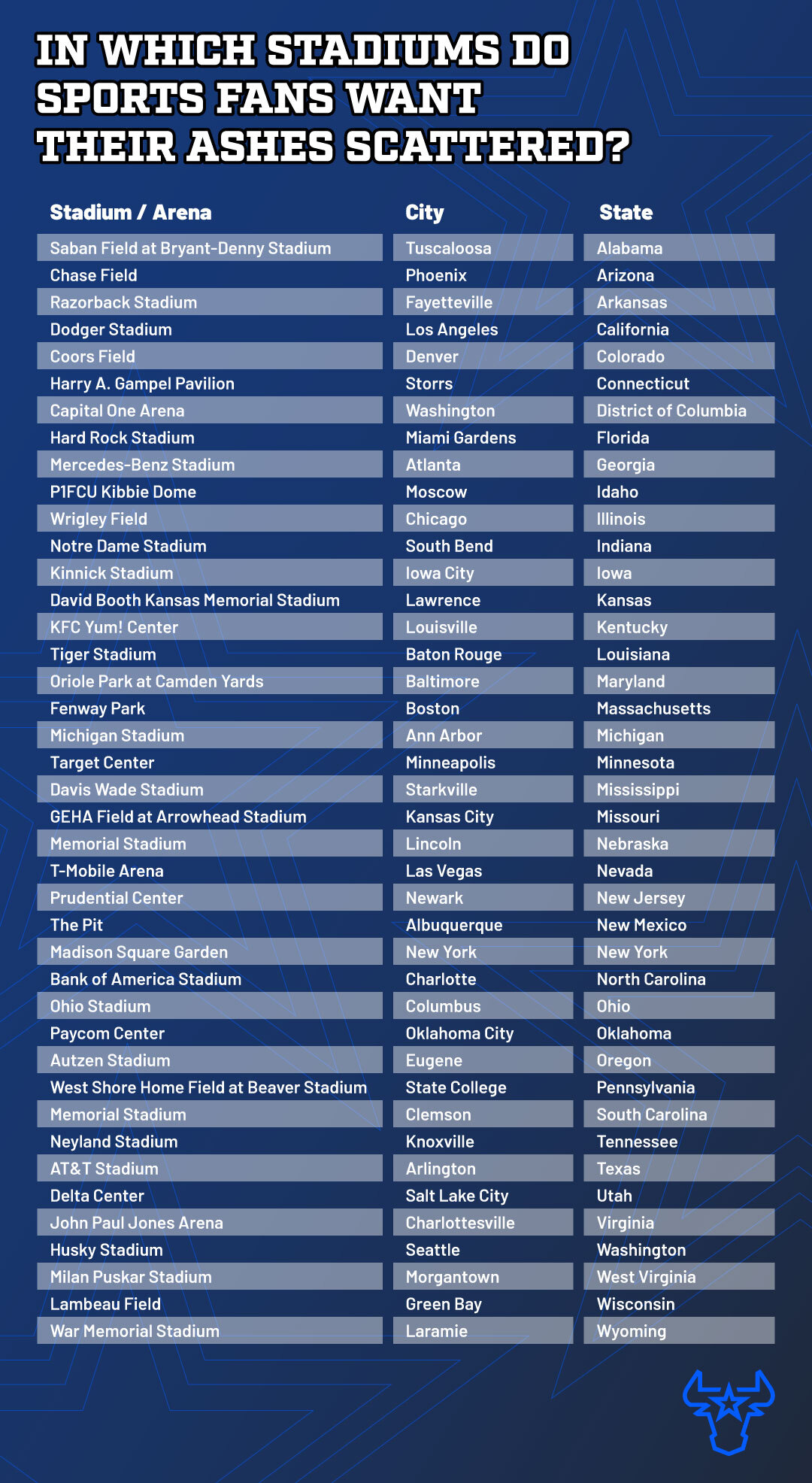
NOTE: States not included did not generate sufficient responses.
"The National Pastime" resonates most with die-hard fans in big cities
When people imagine a place for their ashes, they are not just picking somewhere familiar. They are picking somewhere symbolic. Somewhere that feels like it has weight. In other words, this is less about convenience and more about legacy.
There’s something about baseball that suits this kind of question. The sport is slower, more nostalgic, more rooted in repetition. That makes the idea of “staying there forever” feel strangely natural.
That's certainly the case for sports fans who live in America's largest cities: Dodger Stadium and Wrigley Field were the leading choices for Los Angeles and Chicago, respectively, while Yankee Stadium finished a close second to Madison Square Garden for the most popular venue for scattering ashes in New York.
And let's not forget Boston's hallowed Fenway Park, home of one of the most notable ash-scattering stories (shared here by local legend Matt Damon).
For college football fans, stadiums are sacred ground
For fans in states where college football is king, their choices of where to have their remains scattered lean heavily toward the gridiron. And that should come as no surprise.
Some of the most prominent venues chosen are legendary college football stadiums; the Rose Bowl, Notre Dame Stadium, Michigan Stadium, Ohio Stadium, Tiger Stadium, and Bryant-Denny Stadium among them.
College football is considered intensely tribal, often family-driven, and deeply regional. For a lot of people, these aren’t neutral sporting venues. They are places tied to upbringing, identity, and tradition. Wanting your ashes scattered there sounds dramatic, but in the logic of college football, it also sounds pretty consistent.
Scattering ashes at college football stadiums is such a big topic that it has earned the Reddit treatment for most major NCAA venues. (It's illegal at Notre Dame Stadium, by the way.)
When it comes to a final resting place, history – and atmosphere – matter
Modern venues do appear in the rankings, but many of the most appealing choices are older, storied places with a long emotional trail behind them.
That suggests fans are not simply choosing the nicest or newest building. They are choosing places that feel proven. If the question is where you would want a symbolic final connection, history counts for a lot.
It's also notable that aesthetics, feel, atmosphere and general vibes matter a lot, as well. No one is answering this question like an estate planner. They are not thinking about rules, logistics, or whether this would actually be allowed. They’re thinking symbolically.
And that’s why certain venues rise. Not because they would be easiest to access, but because they represent something. The field, the crowd, the skyline, the history, the feeling of having spent years returning to the same place. This is emotional geography, not practical decision-making.
What makes this ranking interesting is that it turns sports loyalty into something unusually literal. Instead of asking which teams people love most, it asks which places they feel tied to so deeply that they would want one final connection to them.
The answers show that certain stadiums are doing much more than hosting games. They have become emotional landmarks – places fans return to in memory, in habit, and, at least in theory, for good.
