
iGaming Bills Stall as Northeast Casinos Open Up


Long gone are the days of the 1980’s, when Atlantic City was the undisputed gambling destination of the East Coast.
Pennsylvania opened its first land-based casinos in 2006, and Pennsylvania online casinos followed over a decade later in 2017. However, most states in the area that have embraced land-based casinos seem more hesitant to legalize the online version.
In 2020, voters in Virginia approved casino gaming after House Bill 4 was passed by the General Assembly. Currently, Virginia is home to three land-based casinos. However, the state’s Senate Finance and Appropriations Committee recently voted to push House Bill 271, which would have created a new gaming commission to oversee all gaming (including iGaming) in the state, to the 2027 legislative session.
Also, proposed legislation to allow Maryland land-based casinos to expand into the online space is likely to stall ahead of the 2026 legislative session deadline. Two bills that would have jointly introduced iGaming to the Old Line State, Senate Bill 761 and Senate Bill 885, will not progress following the withdrawal of the former.
While supporters of the iGaming House Bill 4431 in Massachusetts argued that legalizing online casinos would bring the state $200 million per year in additional tax revenues, lawmakers recently voted 11-0 to sideline the bill, effectively stalling the proposal.
To date, only seven US states have launched regulated iGaming, including the New Jersey online casino, Delaware, Pennsylvania, Michigan online casino, West Virginia online casino, Connecticut, and, most recently, Rhode Island markets.
As four of these states are located in the Northeast, I went to visit them (and several neighboring states) to check out the current climate and attitudes towards iGaming. Here’s what I found.
Slot cabinets vs. phone screens
I still remember the days when online casinos were available almost everywhere in the US. All you needed was a computer with an internet connection or a mobile phone (although it was still before the days of the iPhone, which kick-started the smartphone revolution, so playing casino games on your phone was more of a gimmick back then). A far different scene from that of real-money online casinos today.
It was the Wild West days of iGaming, with very little regulation (none, in most cases), where most online casinos were run by offshore operators. So, responsible gambling and player protection against fraud or abuse were usually up to the operator’s goodwill.
This all changed in 2006, when the Unlawful Internet Gaming Act (UIGA), a federal law enacted as part of the SAFE Port Act, was passed, putting an end to most offshore casino sites targeting the US. While the law doesn’t make online gambling explicitly illegal, it targets banks and payment processors who handle transactions tied to unregulated online gambling activities.
In 2013, states including Delaware and New Jersey legalized online casinos, while Nevada legalized online poker. However, unlike the best sports betting apps, which have been spreading quickly across states since Nevada lost its near-monopoly in 2018, state legislators have been much slower to legalize online casino gaming.
New York
State laws currently prohibit New York online casinos, despite the state’s mobile sports betting market, which was legalized in 2021 and launched in 2022. Senator Joseph P. Addabbo Jr. (D), a longtime proponent of iGaming in the state, has reintroduced Senate Bill 2164, which would legalize online casinos in the Empire State.
While the bill is under review, I went to check casino projects that are grabbing more headlines – namely, the three approved casinos in New York City. While I’ve noticed some heavy machinery parked at Metropolitan Park, where Hard Rock Casino is expected to be open around 2030, there’s not too much else going on there at the moment.
However, this isn’t the case at Resorts World in Ozone Park, where there’s the Aqueduct Racetrack and a full-fledged casino with slot machines and virtual table games. The new legislation will also bring human dealers to the property. Whether online casinos will follow remains unclear, as there’s opposition to land-based casinos that will probably need to be overcome first.
Massachusetts
I also went to visit Massachusetts’s three gambling sites, starting with Encore Boston Harbor, then driving to MGM Springfield, and finishing at Plainridge Park (a racino, not a full-fledged casino). While the casino floors were buzzing in all three properties, I spoke to locals who were gambling on slot machines, table games, and placing sports wagers on March Madness in the sportsbooks.
“I think they should just go for it,” said Caleb J., who lives in the greater Springfield area, when I asked him about iGaming legislation. “Here we are, sitting in the BetMGM sportsbook, and I can just put bets on my March Madness bracket on my phone. So why can’t I play slots on my phone too?” Unless travelling to nearby Rhode Island, Caleb won’t get a chance to play slots on his phone anytime soon.
Rhode Island
Online casinos have been legal and available in Rhode Island since 2024. And although it’s the smallest US state by land area and one of the smallest by population, with just over 1.1 million people, mobile casino gaming draws many visitors from neighboring states, such as Massachusetts.
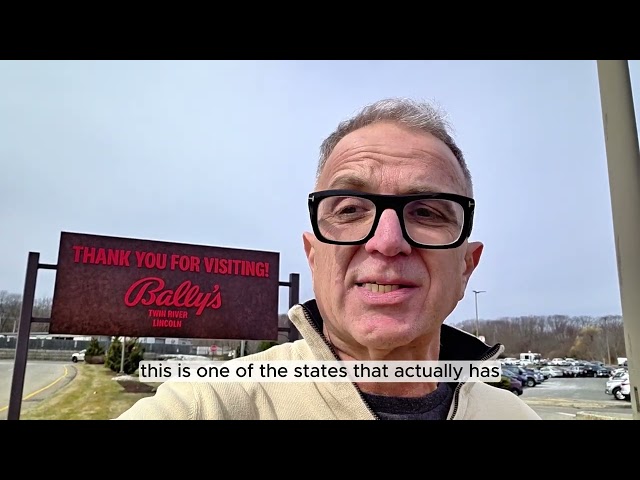
As the state runs its gambling through a lottery model, there’s only one operator: Bally’s. The brand operates two land-based casinos across the state: Bally’s Twin River Lincoln and Bally’s Tiverton. There’s also just one online platform, BallyBET, for both sports betting and online casino games. I’ve noticed heavy promotions across the casino floors for the online brand.

Pennsylvania
Pennsylvania’s legal and regulated iGaming market launched in 2017, and the Keystone State’s first online casinos were launched in 2019. Currently, there are about 22 online casino brands live in Pennsylvania, where the state operates a ‘skin model’, allowing each land-based casino to operate online brands through partnerships.
While visiting Rivers Casino in Pennsylvania, which operates the BetRivers online casino and sportsbook brand, I spoke to Marie D, who lives in Philadelphia, and asked her if she also gambles online. She said, “I sometimes play the slots to collect bonus and rewards points, which I then come and spend here [at Rivers Casino in Philadelphia]. But I don’t play a lot online, for me, the casino is a social experience, a day trip out, something fun to do.”
I then went to Parx Casino, where I’ve seen on the casino floor promotions for betPARX, the casino’s online brand. I also went to visit Live! Casino in Philadelphia, and asked visitors about the PlayLive! brand.
“Yes, I love to play online, said one of the people I’ve interviewed, especially live dealer blackjack, which gives me a bit of a feeling of playing in real life, as I would here, although it’s not the same at all,” said Seth from Morristown, Pennsylvania. “Still, I can’t come here that often, so whenever I feel like playing a bit, my phone is a good option.”
New Jersey
New Jersey was one of the pioneering states in iGaming, launching its first online casinos in 2013. Each of Atlantic City’s nine casinos can host multiple online brands (or ‘skins’), bringing the count to about 30 brands, as some sources count brands and apps separately.
New Jersey’s online casinos generated $251 million in revenues in February, compared to Pennsylvania’s online casino revenues of $300 million for the same period. However, this may also reflect the difference in population size, with New Jersey and Pennsylvania estimated to have populations of 9.7 and 13.2 million, respectively.
I’ve visited nearly all the casinos in Atlantic City, most of which have online presence, either through their own brands or through partnerships. Speaking with people on the casino floor, reactions to online casinos were mixed. “I love it. Whenever I go across the bridge to Jersey, and I have time on the train or between meetings, I just fire up a casino app on my phone and play,” said Dan, who lives in New York City.
However, some weren’t as enthusiastic. “Online casinos killed us. It used to be full here, with people from all over the East Coast coming to gamble, party, and just have a great time,” said Carole, an Atlantic City native. “But now, you can see here empty tables. It’s not only casinos opening up in other states on the East Coast, but it’s also the online casinos that are competing with Atlantic City.”


Related Articles


